The language problem . . .
Ok, not really a problem, more of a situation.
Short version: thinking has less to do with language than you think.
This is a controversial subject, because it is counterintuitive. Most folks confuse their interior dialog with thinking. That's not what thinking is.
Not all linguistics agree with that statement. The Sapir-Whorf hypothesis, aka linguistic relativity, posits that the structure, grammar, and vocabulary of a native language shape how its users think and perceive the world. There are still researchers extolling the benefits of a weak interpretation of linguistic relativity, but the idea is not a modern one. I'm uncomfortable with drawing large-scale conclusions from a detail about a random noise Russians make when describing a place on the color spectrum. Arbitrariness still works for me, I take it as a given.
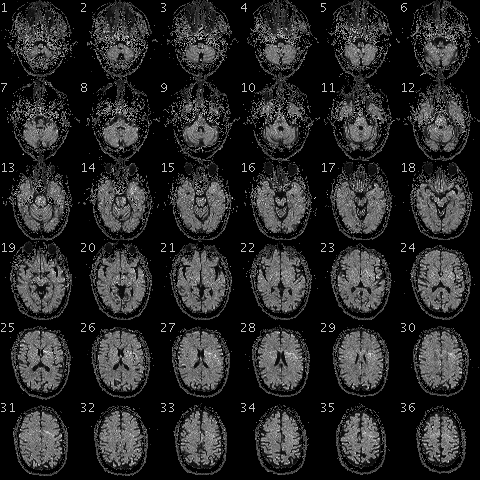
My opinion is that language developed as a tool for representing and referring to qualia, the internal, subjective, and individual reality that a conscious entity experiences. As a subjective experience, it is not available to standard physical measurements. That being said, we can certainly scan brains that are perceiving things in the real world.
Now, most people would not confuse a brain scan with thought. Neither is a colonoscopy digestion, an eye exam is not vision, and the results of spirometry will not deliver oxygen to your blood.
Language is an abstract representation of thought, a description of what thought does, what it is like, and by extension what the world is like. But it is not the thing in and of itself (Kantian Ding an sich).
I have to explain this to students from time to time. People who want to improve their performance in another language often rely on translation and vocabulary sets. These are useful as a crutch for a while, especially for beginners or children. There is no relationship between a word for something in one language and a word for something in another language.
What I do is draw a cup of coffee on the flipchart or whiteboard. I then ask them if they can drink from that cup. And they say, "of course not". I then label the drawing with an assortment of lexical items that describe a cup of coffee in German and English, sometimes Spanish or Portuguese, or I solicit terms from the participant's own native languages.
Now what I don't tell them is that there is a valence (as in the degree of a node — how many edges it has) between the words for a thing or process in multiple languages, it is known as semantic alignment. In LLMs this is what gives us models that can translate. And another alignment, description with a depiction: modality to modality, image↔textdescribe, gives you the option to spin up a wonderful meme or tasty slop image. These are two different maps, but let's not get ahead of ourselves.
The point is that there is no connection between Tasse (German for cup) and the lexical item /cup/ in English, at least for humans. The connection is between the cup and the word in all languages, or the action of holding your hands in a way that acts as a vessel, cupping your hands in English. People who have learned languages by studying lists of words in pairs are setting themselves up for failure. It's one reason why they can't remember those words. The signal (word) is paired with the qualia (experience) in your mind.
Inquisitive types want to know why there is a difference between a cup and a mug, which has less to do with function and more to do with shape and etiquette.
Now there is a phenomenological and philosophical bend to this that I'd like to address here. If, like me, you've spent over forty years (or maybe less if you are younger) meditating, there is a clearly perceivable difference between thinking and language. The goal in many kinds of meditation is to silence the internal dialog. It is in Zazen, which I practice. But thinking is still possible without that layer of language over it. And I'm not the only one to perceive it, probably everyone whose ever settled their ass on a zafu for any length of time can confirm. Brains don't need language to think.
Human thinking is the original always on computational model and turning it off is the hardest thing you could ever try.
There is a famous Buddhist parable frequently cited by and attributed to Dōgen (but older, in the Śūraṅgama Sūtra) "mistaking the finger for the moon" that warns against confusing an indicator with reality. But it's not an esoteric idea, it's not just for monks or wallfacers.
Alfred Korzybski's "The map is not the territory" is a mental model representing the truth proposition that our conceptual representation or belief about something is never reality. This is what confuses people about thinking, we mistake the internal dialog, our description of what we are thinking, with the thinking itself.
In this century, Evelina Fedorenko, a neuroscientist at the McGovern Institute for Brain Research at the Massachusetts Institute of Technology has been conducting research with her colleagues that validates the idea that language does not equal cognition. This flies in the face of the previous generation of linguists at MIT, including Noam Chomsky, who argued that thinking was why language evolved.
So now, humans have created another class of "thinkers", these thinkers are built on language, they think using language and we interact with them using language. Language is no longer the exclusive province of the human (animal) world. I'd like to suggest that they are languagers, not thinkers. The output is inference in the form of language, because that's what they are trained on. They come about that use of language in a way that we don't. Language is a cultural imperative for humans because we are animals, LLMs are not animals.
So, the hairless monkey compiled a friend, a non-monkey language user who enthusiastically interacts with him.